Friday, 23 March 2018

Inside Michael Dell’s Sprawling Property Empire


Based out of Austin, Texas, the tech mogul has snapped up two super-deluxe condominiums in New York and Boston in recent years

Michael Dell is in contract to buy a penthouse at One Dalton Square in Boston.
Michael Dell is in contract to buy a penthouse at One Dalton Square in Boston. PHOTO: JASON GROW FOR THE WALL STREET JOURNAL
Known for his lavish spreads in his hometown of Austin, Texas, and on the Big Island of Hawaii, tech mogul Michael Dell has expanded east, buying two super-deluxe high-rise homes in Boston and in New York City in recent years.
In 2014, Mr. Dell, 53, spent $100.47 million on a penthouse on New York’s Billionaire’s Row, setting a record for the city’s priciest home purchase, people familiar with the transaction said. Last year, he snapped up a penthouse seeking $40 million at the Four Seasons Private Residences One Dalton Street in Boston.
Michael Dell, founder of Dell Technologies
Michael Dell, founder of Dell TechnologiesPHOTO: GETTY IMAGES
The purchases significantly add to Mr. Dell’s real-estate holdings, according to a Wall Street Journal analysis. Before these buys he owned two homes around his hometown of Austin, Texas, and a third retreat on the Big Island of Hawaii’s Kohala coast.
A college dropout, Mr. Dell earned his fortune by starting Dell Technologies , which makes and sells personal computers and other technology products. Most of that fortune lies in his private-investment firm MSD Capital, which was set up to manage his family’s fortune. MSD Capital’s real-estate holdings are purely for investment purposes, a person familiar with his investment strategies said, such as a home in Los Cabos, Mexico, which is on the market for $18.5 million.
Here is a snapshot of Mr. Dell’s personal properties.
A aerial view of Mr. Dell’s approximately 33,000-square-foot compound in Austin, Texas.
A aerial view of Mr. Dell’s approximately 33,000-square-foot compound in Austin, Texas. PHOTO: PICTOMETRY
Austin
In Austin, Mr. Dell built an approximately 33,000-square-foot compound for his family. He and his wife, Susan, completed the property in 1996, according to a person familiar with the project, the same year his company launched its website Dell.com.
Mr. Dell tapped New York City firm Gwathmey Siegel & Associates Architects —whose founder Charles Gwathmey was best known for designing homes for the likes of Steven Spielberg and David Geffen. Juan Miro, an architect from the firm, was dispatched to Texas to oversee its completion, the person said. Gwathmey Siegel’s style is famously modernist and geometrically complicated, and Mr. Dell’s granite and stainless-steel house is no exception. It has eight bedrooms and 16 bathrooms, a home gym and an indoor lap pool. A stairwell includes polished wood panels and a bowed steel banister, which frames a sculpture by artist Joel Shapiro.
Property records show that Mr. and Mrs. Dell own several vacant lots adjacent to their property, bringing the total compound to about 119 acres. The adjacent lots all have a conservation easement, meaning they are permanently restricted from being developed. The property is a 20-mile drive from Round Rock, Texas, where Dell Technologies is based.
In 1997, Mr. Dell challenged his $600,000 property-tax bill after county assessors valued the home at $22.5 million, according to legal filings. At the time, Mr. Dell’s attorney said his client had spent about $30 million on improvements to the property. The resolution wasn’t disclosed.
In the hills about 12 miles away, Mr. Dell also owns a quirky geometric house known as 6D Ranch. Named after the six members of the family, it is where their Arabian horses are kept, according to a person familiar with the property.
The three penthouses at the Four Seasons Private Residences One Dalton Street were most recently on the market for about $40 million.
The three penthouses at the Four Seasons Private Residences One Dalton Street were most recently on the market for about $40 million. PHOTO: JASON GROW FOR THE WALL STREET JOURNAL
Boston
In September 2016, Dell Technologies completed an approximately $67 billion deal to acquire EMC, a company dealing in data storage and data protection, marking what was then the largest technology merger in U.S. history. EMC would keep its operations in Hopkinton, Mass., where it is located, according to a statement from the company at the time.
In 2017, Mr. Dell inked a contract for a penthouse at the Four Seasons Private Residences One Dalton Street, according to people familiar with the transaction.
The tower will be Boston’s tallest residential building when it is completed next year. The unit is one of three penthouses and was most recently on the market for about $40 million. The building’s three penthouses have soaring ceilings and double-height terraces with outdoor fireplaces, according to the project’s website.
Mr. Dell quietly purchased a $100.47 million penthouse at New York’s One57 tower in 2014.
Mr. Dell quietly purchased a $100.47 million penthouse at New York’s One57 tower in 2014. PHOTO: AFP/GETTY IMAGES
New York
Mr. Dell’s $100.47 million purchase at One57, the more than 1,000-foot condo tower on Manhattan’s West 57th street, set the record for the most expensive home ever sold in New York City. His aerie totals 10,923 square feet, with six bedrooms and six bathrooms, according to an offering plan for the project. The building’s glassy units have sprawling views of Central Park.
Luxury agents say building’s reputation as the pinnacle of prestige has faded. “When he bought it, it was the symbol of success for supertalls,” said New York appraiser Jonathan Miller. “Since then, it’s been mired in a lot of negative stories about unsold units and new competition from other projects.” A buyer who paid $32 million for an apartment at One57 in 2014 sold it for $23.5 million in 2016, public records show.
A bird’s eye view of Mr. Dell’s Hawaii estate, which is known as the Raptor Residence.
A bird’s eye view of Mr. Dell’s Hawaii estate, which is known as the Raptor Residence. PHOTO: PICTOMETRY
Hawaii
MSD Capital has been a major investor in Hawaii since 2004, when it bought the Four Seasons Maui. In partnership with former Walmart chairman Rob Walton, it also owns the entirety of Hualalai, a master-planned residential community on the Big Island surrounding the highly rated Four Seasons there.
Mr. Dell’s personal home is located in the nearby, exclusive residential community of Kukio. Unlike other Hawaiian coastal communities, Kukio is accessible only to homeowners and their guests. Visitors need permission of a homeowner to enter. A clubhouse in the community fronts Hawaiian fish ponds and an archaeological reserve, with views of the island of Maui, according to the community’s website.
Mr. Dell’s home appears to be the largest in the community at 18,500 square feet and with seven bedrooms, according to plans. People call the property Raptor Residence, as Mr. Dell purchased it in under a limited-liability company of that name.

Sunday, 4 February 2018

Daniel Kahneman, “following their changes constantly is a very, very bad idea. It’s the worst possible thing you can do, because people are so sensitive to short-term losses.


“If owning stocks is a long-term project for you,” warns psychologist Daniel Kahneman, “following their changes constantly is a very, very bad idea. It’s the worst possible thing you can do, because people are so sensitive to short-term losses. If you count your money every day, you’ll be miserable.”

https://www.safalniveshak.com/dealing-stock-markets-moments-terror/

Dealing with Stock Market’s Moments of Terror

I received this Whatsapp message from a friend recently, where he wanted my opinion on the post-Budget crash in Indian stocks and how to deal with the same…

My friend’s message reminded me of Howard Marks’ Feb. 2016 memo to clients, where he described the situation in the stock market then –
My buddy Sandy was an airline pilot. When asked to describe his job, he always answers, “hours of boredom punctuated by moments of terror.” The same can be true for investment managers, for whom the last few weeks have been an example of the latter. We’ve seen bad news and prices cascading downward. Investors who thought stocks were priced right 20% ago and oil $70 ago now wonder if they aren’t risky at their new reduced prices.
In the rest of the memo, he went on to explain why Mr. Market – representative of the stock prices – has nothing valuable to offer to investors through his daily mood swings. As he writes –
Especially during downdrafts, many investors impute intelligence to the market and look to it to tell them what’s going on and what to do about it. This is one of the biggest mistakes you can make. As Ben Graham pointed out, the day-to-day market isn’t a fundamental analyst; it’s a barometer of investor sentiment. You just can’t take it too seriously. Market participants have limited insight into what’s really happening in terms of fundamentals, and any intelligence that could be behind their buys and sells is obscured by their emotional swings. It would be wrong to interpret the recent worldwide drop as meaning the market “knows” tough times lay ahead.
…It is the goal of some investors to sell on declines when the subsequent movements will be down, but “buy the dips” when the subsequent movements will be up. If you think you can tell which is which from watching the market movements themselves, then we – again – have a fundamental disagreement. Future price movements can only be predicted on the basis of the relationship between price and fundamentals. And, given the market’s short-term volatility and irrationality, this can only be done in the long-term sense. The market has nothing useful to contribute on this subject.
“Predicting the subsequent movement of stock prices,” I called and told my friend, “or the next mood swing of Mr. Market, whether he will be in the best of his spirits or worst – is a loser’s game. Focusing on where the earnings and cash flows of the underlying businesses you own, or want to own, are going to go long term is what you must focus on.”
I also told him, “Your behaviour and expectations are under your control, and so is the amount of risk you wish to take and the time you have in hand. Stock prices and future returns aren’t under your control and thus you must leave them at what they do best, that is, fluctuate.”

“If owning stocks is a long-term project for you,” warns psychologist Daniel Kahneman, “following their changes constantly is a very, very bad idea. It’s the worst possible thing you can do, because people are so sensitive to short-term losses. If you count your money every day, you’ll be miserable.”
My dear friend, please stop being miserable!


Thursday, 7 December 2017

On failing - One Immigrant’s Journey From Washing Cars To Uber’s CTO

Car washing. Wearing donated clothes and shoes. Working at the local public library. Surviving on state welfare to put food on the table. Taking care of his younger brother while his mother took on two jobs at a gas station and supermarket to keep the lights on at home. Thuan Pham arrived in the United States from Vietnam as a refugee when he was 11 years old.

Pham was born in Vietnam in the late 1960s, to parents who barely finished high school. Due to the political situation in Vietnam, it became increasingly unsafe for Pham and his family to stay in the country, and hence his mother made a decision to leave the country. Pham’s mother sold everything they had in order to pay for the journey but failed a couple of times to escape as the arranged boat did not show up. The boat finally showed up; but during the journey, Pham and his family were pirated twice.

They finally landed at a refugee camp in Indonesia, where they lacked shelter and sanitation for weeks, and ended up spending 10 months there. Pham would swim to nearby islands to buy candies, which his mother would use to trade for bread for the family. Pham’s mother believed that it was better to take a risk to leave the country than to grow up without opportunities for a better life. Eventually, Pham’s family arrived in suburban Maryland in the United States where Pham started a new life.

In Maryland, Pham worked hard and hustled as a teenager to do well in school, to overcome the language barrier, and to work to support the family. He quickly became the adult in the family, taking care of his younger brother and household chores, while washing cars and working at the local public library. Often, he would be working long hours washing cars in the weekends to earn some extra money, even when it was cold in the winter. At the local library, he started to develop an interest in coding by fiddling around with the public computer terminals. This was when he started to realize he had a natural affinity for programming.

In order to further develop his interest in programming, Pham volunteered his services at the local government agency, National Bureau of Standards Publications, where using Lotus, he automated the entire accounting system for the team within 3 months. As a result of his extra-curricular involvement and excellent academic record, Pham was admitted into MIT to study computer science in 1986, and graduated in 1991. In the same year he graduated, Pham would see his father for the first time in ten years when he finally got a visa to visit the United States for Pham’s MIT graduation.

From MIT, Pham went on to work for HP Labs, Silicon Graphics, DoubleClick, and VMWare. He joined Uber in 2013 as Chief Technology Officer, when the company was present in 60 cities and employed about 200 people. Pham had always favored working at smaller companies in his career. He started off his career at HP Labs, which was a research-focused and academic environment, and that allowed him to focus on learning the latest technologies. However, he soon wanted to explore something new. In his career, Pham always prioritized learning over other criteria. He was not afraid of a company failing, because as an immigrant, you knew that you could always start afresh if need be.

Finishing up our conversation on market street off downtown San Francisco, I was curious of how Pham gets around these days, and if Uber provides their CTO with ride-hailing services to make his journey to work more comfortable. As Pham stood up to walk back to his desk, he shared that he has been taking the Caltrain (California’s public transport system) from San Jose everyday to get to San Francisco, a total of a 3-hour commute daily, but he spends the time wisely by clearing emails or doing one-on-ones with his colleagues for feedback.

https://www.huffingtonpost.com/entry/one-immigrants-journey-from-washing-cars-to-ubers_us_5a1f017ce4b00579aa29f9d6


Wednesday, 6 December 2017

If you think about any retail concept, value will always be an important element, whether you're selling clothes or hamburgers and fries

The strategy for a successful dollar menu is to hope people order more items, and then more expensive items, so that the restaurant ends up with a profit in the deal.

"It could be a situation where someone goes in thinking about buying one thing and then gets thinking, 'This is pretty reasonable,' and going to add on a few things," said R.J. Hottovy, a restaurant analyst at the investment research firm Morningstar.

Just about all fast-food chains are in the value game — even if it isn't at the $1 level.

Burger King has a Value Menu. Wendy's has the Right Price Right Size Menu. Then, Dairy Queen, KFC and  Carl's Jr./Hardee's all have $5 meal deals.

A rebounding economy doesn't nix the need for value options on menu boards. Low- and middle-income consumers continue to feel the pressures of stagnant wage growth and higher rents and health care costs. They'll gravitate to the value menus.

"We’ve always known customers love the idea of value at McDonald's. That's never changed. What's evolved is they want more choice, but with the familiarity of the original Dollar Menu," said McDonald's U.S. president Chris Kempczinski about the new $1 $2 $3 Dollar Menu. "If you think about any retail concept, value will always be an important element, whether you're selling clothes or hamburgers and fries."

https://www.usatoday.com/story/news/2017/12/06/mcdonalds-taco-bell-others-pile-just-buck-deals/923029001/

Tuesday, 31 October 2017

Position Sizing for active trader; If you don't bet you can't win


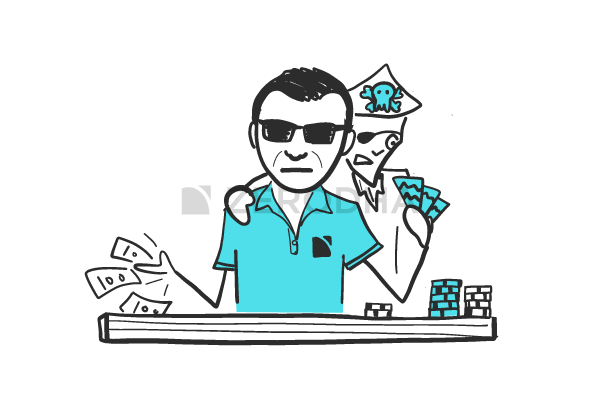
11.1 – Poker face

Last month I got an opportunity to play poker with a few good friends. I was playing poker after a gap of 6 years and I was quite excited about it. The buy in for this friendly game was Rs.1000/. For those who are not familiar with poker – it’s a card game where in your skill and luck are tested in equal measure.
So, the game started, cards were dealt, and in the very first round I bet Rs.200/- and I saw it go away, just like that. In the next round, I bet another 200, and again saw it go away. At this stage I convinced myself that I could make up my losses in the 3rd round, and with this thought I increased the bet size to 600, only to watch it go away! So for all practical purposes, I lost Rs.1000/- in a matter of 10 minutes! In the trading world, this is equivalent to blowing up your entire trading account.
I didn’t give up, after all, I’m supposed to know trading and poker draws many similarities to trading. I decided to ‘recover’ my initial loss and stay in the game longer. I bought in for another 1000 and started fresh. This time, I stayed on the table a bit longer – for a total of 15 minutes!
Clearly, it was not working for me. I had a better memory of me playing poker 6 years ago. Though not the best, at least, I would stay on the table till the game lasted and even win few hands. So what was happening this time around? I was confused and I kind of didn’t believe that this was happening to me? How could I wipe my account twice in a matter of 25 minutes?
With these confusing thoughts on my past poker skills and my current game play, I decided to buy in again for another 1000 Rupees. This was my 3rd buy in. In the trading world, this is equivalent to funding your account 3rd time over after successfully blowing it up twice.
What advice would you give someone who has blown up his account twice in the markets? – ‘get out of the markets immediately’, would perhaps be the best-suited advice right? Well, I dint pay any heed to my inner voice, gambler’s fallacy had taken over my rational thinking abilities and I bought in again for 1000 Rupees more.
For those of you who don’t know gambler’s fallacy – if you are betting on an outcome and you tend to make a long streak of losses, then at the time of quitting, your mind tells you or rather tricks you to believe that your losing streak is over and your next bet will be a winner. This is when you increase your betting size and lose a bigger chunk of money. Gamblers fallacy is one of the biggest culprits in wiping out many trading accounts clean.
Anyway, back to my poker game. This was my 3rd buying, I had already lost 2K and was betting with another 1K. I was confident I’d recover plus make some money and save myself some shame, but the boys on the table had other plans for me. They knew I was the sucker on the table and it was easy to allure me to make irrational bets. So they did and wiped me out clean over the next 7 minutes.
That was it, I called it quits and I got back more after losing 3k.
After the game, I thought through on what went wrong. The answer was very clear –
  1. I had forgotten to recognize the odds of winning with the cards that were dealt
  2. I was not ‘position sizing’ my bets – my bets were way too irrational and random
After a couple of weeks, I had another invite to the game. I had set a bad precedence of giving away easy money. This time around I had decided to position size my bets well.
I bought in for 1000 and started the game. Each time the cards were dealt – I accessed my odds fairly well and if I thought my odds were fair, I bet accordingly. In the trading world, this was equivalent to following a ‘trading system’ backed by position sizing techniques. The result of this simple systematic approach had a great impact on my game –
  1. I won few hands
  2. At the peak, I must have had about 4K of winnings
  3. I lasted throughout the game and had a lot of fun along the way
  4. Towards the end I gave up some gains but was extremely happy with the fact that few simple techniques helped me manage my game much better
Position sizing made all the difference in this game. It always does and this is the exact reason for me to narrate this story. I do not want you to speculate in the markets without understanding your odds or without position sizing your bets. If you do, you will end up making a fool out of yourself.
Poker is played for fun but when you trade, you are essentially deploying your capital for a more serious and meaningful outcome. So please do pay attention to some of the things we will discuss over the next few chapters. I’m certain it will have a positive impact in your trading career.
At this point I have to mention this – I myself learned position sizing many years ago by reading Van Tharp’s books. Van Tharp is one of the most prominent people to bring in the concept of position sizing to traders. I’d even recommend you buy some of his books to expand your knowledge on this subject.

11.2 – Gambler’s fallacy

We briefly discussed the gambler’s fallacy early on. I guess it makes sense to discuss a little more on this at the very beginning especially in the context of markets.
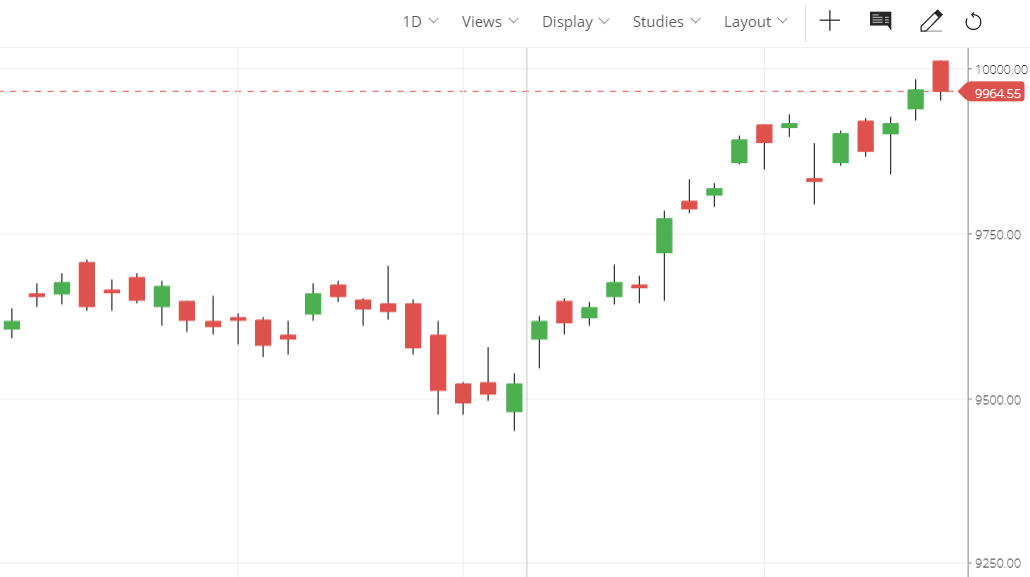
Take a look at this chart –
This is the chart of Nifty – Nifty hit the magical number of 10,000 on 25th July 2017. As a trader, how would you trade this?
  1. Nifty is at an all-time high – 10K
  2. Many market participants may book profits at this point – considering it is a phycological level
  3. All time high implies no resistance points
  4. Nifty has been in a great up wards trend over the past few weeks
  5. Maybe Nifty would consolidate around these levels?
  6. Maybe a correction of 2-3% before the rally continues?
Let us just assume that these are some valid points for now. This means a short position is justified or for that matter buying of puts. Your analysis could be as simple as this or as sophisticated as studying the time series data and modeling the same using advanced statistical or machine learning models.
Irrespective of what you do – there is no certainty in the markets. No one technique will tell you the outcome in advance. This implies that we are dealing with fairly random draws here. Of course, based on how meaningful your analysis is, your odds of winning can improve, but at the end of the day, there is no certainty and you have to acknowledge the fact that markets are indeed random.
Now imagine this – you have done a state of the art analysis and you place your bet on Nifty only to see the stop loss trigger. You do not give up, you place another trade and to your misfortune, you are stopped out again. This cycle repeats for say the next 4 trades.
You know your analysis is bang on – but then your stop loss is continuously getting triggered. You still have money in your account to take on bets, you are still convinced that your analysis is rock solid and the markets will turn around, you still have an appetite for risk – given all these, what do you do?
  1. Would you stop trading?
  2. Would you risk the same amount of money again?
  3. Now that you have lost 6 consecutive bets, would you consider that your odds of making money on the 7th trade is higher and therefore increase your bet size to recover your previous losses plus reap in some profits?
Which option are you likely to take? Take a minute and answer this question honestly to yourself.
Having been through this situation myself and having interacted with many traders let me tell you – most traders would take the 3rd option, the question however is – why?
Traders tend to believe that long streaks will cease when they take the ‘next’ trade. For instance, in this case, the trader has faced 6 consecutive losses, but at this point his conviction that the 7 trade will be a winner is very high. This is called ‘Gambler’s fallacy’.
In reality, when you are dealing with random draws, the odds of making a loss on the 7th trade is as high (or low) as it was when you placed your first bet. Just because you have made a series of losses, the odds of making money on the next trade does not improve.
Traders fall prey to ‘Gamblers fallacy’ and often end up increasing their bet sizes without understanding how the odds stack up. In fact, gamblers fallacy ruins your position sizing philosophy and therefore is the biggest culprit in wiping out trading accounts.
This works on the other side as well. Imagine, that you are fortunate enough to witness a 6 or let us say 10 consecutive wins. Whatever you bet on, the trade works out in your favor. You are on your 11th trade now, which of the following are you likely to do?
  1. Considering that you made enough money, would you stop trading?
  2. Would you risk the same amount again?
  3. Would you increase your bet size?
  4. Will you take a conservative approach, maybe protect you profits, and therefore reduce your bet size?
Chances are that you will take the 4th option. You clearly want to protect your profits and do not want to give back whatever you have earned in the markets and at the same time you would want to take a trade considering you have had a great winning streak.
This is again ‘gamblers fallacy’ at play. Being completely influenced by the outcome of the previous 10 trades, you are essentially reducing your position size for the 11th trade. In reality, this new trade has a same odds of winning or losing as the previous 10 bets.
Perhaps, this explains why some of the traders, even though get into profitable trading cycle end up making very little money.
The antidote for ‘Gambler’s Fallacy’, is position sizing.

11.3 – Recovery trauma

In the trading world, the capital we bring on the table is the raw material. If you do not have enough money to trade with, then how will you make a profit? Hence we need to not just protect the profits that we make, but also protect the capital.
Extending this thought – if you risk too much capital on any one trade, then you stand a chance to risk your capital to an extent that you may burn your capital leaving you with very little money. Now if you are trading with very little money, then every trade that you take will appear to be too risky. The climb back to where you started will (in terms of capital) will be a Herculean task.
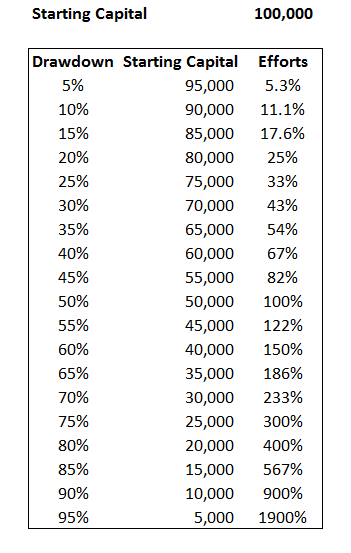
I have prepared a table to help you understand this fact. Assume you have a trading capital of Rs.100,000/-. Let us see how the numbers stack up with –
You can download the excel sheet here.
Assume you lose 5% of your capital or Rs.5000/-. Your new starting capital is Rs.95,000/-. Now, in order to recover to Rs.5000 with a capital of 95000, you need to generate a return of 5.3%, which is 0.3% more than what you lost.
Now, instead of 5%, assume you lost 10% and your capital becomes 90000, now in order to recover 10000 or 10% of your original capital, you have to earn back 11.1%. As you can see, as the loss deepens, you will have to work really hard to bounce back to original starting capital. For example at 60% loss or original capital, you are staring at a 150% bounce back.
Unfortunately, the ‘recovery trauma’ affects traders with smaller account size. Assume you come to the market with Rs.50,000/- capital. Now you would have heard of stories on how Rakesh Jhunjhunwala, grew his money from 10,000 to 15K Crores. You would want to replicate at least a small portion of this success. Honestly speaking, if you can manage to grow Rs.50,000/- to say Rs.60,000 by the end of the year, you would have done a great job. This translates to a 20% return. But this is not exciting, right? I mean earning Rs.10,000/- over 1 year when you are actively trading somehow does not seem right.
So what do you do? You tend to take bigger risks and hope to make bigger gains, and if the trade goes against you, then you are essentially falling prey to the ‘recovery trauma’ phenomena.
This is exactly the reason why you should never risk too much on any one trade, especially if you have a small capital. Remember, your odds of making good money in the markets is high if you can manage to stay in game for long, and to stay for a longer period, you need to have enough capital, and to have enough capital, you need to risk the right amount of money on each trade. This really boils down to working towards longer term ‘consistency’ in markets,  and to be consistent you need to position size your trades really well.
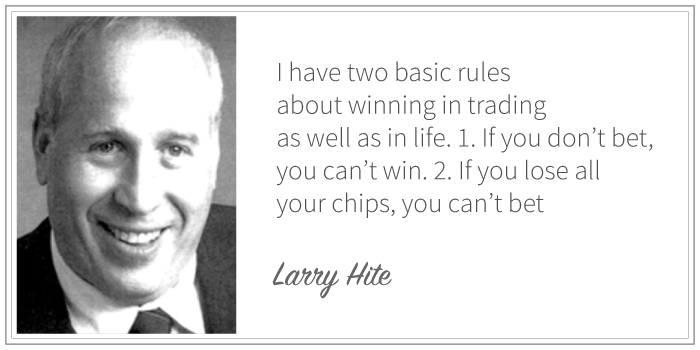
I’m going to close this chapter with a quote from Larry Hite.

Over the next few chapter, we will dig deeper into position sizing techniques.

Key takeaways from this chapter

  1. Position sizing forms the corner stone of a trading system
  2. Gamblers fallacy is a bias highly applicable to the trading world. It makes the trader believe that a long streak of a certain outcome can break
  3. When there are infinite draws, the odds of making a profit or loss on the Nth trade is similar to the odds of making the same profit or loss on the 1st trade
  4. The recovery of capital is much more difficult task than one can imagine
  5. Traders with small accounts have a tendency to take larger bets, which they need to avoid

Zerodha 60 day challenge trade winners

10th Std Pass, Market Wizard from Thrissur

Summary

1. 10th class pass - more education seems to be a disadvantage with trading
Perhaps, lack of higher education is what made him a small player relative to other players like Rakesh Jhunjhunwala or Mankekar. He may not have the 'theoretical' background to succeed further.

2. Risk Management 
Also, from when I started, I have made sure that only a small portion (1 to 3%) of my net-worth is used for trading, I guess that is the money management rule that you are asking me for.


MAY 22, 2014CATEGORY: Winners - 60 day challenge

Traders,
After putting up the first five interviews of some of our top traders and winners of the Zerodha 60 day Challenge, I was asked many times if engineers have better odds to win at trading, as each one of the five featured until now came from a similar background. The search to break the pattern amongst our winners ended at Joby, a 10th standard pass-out from a small town in Kerala with no access to fancy tools or resources, who has still managed to be up over 300% from active F&O trading in the last couple of years trading at Zerodha. His winnings from the market runs into crores over the many years trading F&O actively. I had to use a translator as the only language he speaks is Malayalam.

Following is my interaction with Joby.
Name: Joby      Age: 47 Years
joby

Running a Bakery to Trading full time. How did that happen?
I was running my own Bakery in the early 1990′s and had people visiting the shop regularly after trading at the Cochin Stock Exchange. The bug bit me and without any knowledge of capital markets, I quit my bakery business to become a full time equity trader. Until 2000, my trading was only in equities and I started trading F&O when it was introduced in 2001. I am thankful to God that the risk I took by shutting down my bakery worked out well for me.

How much money did you start off with?
It all started with just around Rs 500 back when I started and today whatever I have made is all out of that Rs 500. Over a period of 22 years, I have also taken profits out of trading and invested into other avenues, and that trade also has worked out very well.

Investment into other avenues? Why not into stocks?
I have always traded the markets, but all my investments till date have never been in stocks. I guess the reason for this is because it is very tough to trade and invest at the same time, I was never comfortable doing that.  For example, I am shorting Nifty futures because I am feeling bearish, but what do I do with the stocks that I am holding for long term–hold or sell? It is very easy to say that you will hold for long term, but such scenarios where there is indecision or time taken can be detrimental to the outcome of your trade.

What do you trade on, mostly? Are they intraday or positional?
I have mostly been trading options from when it was introduced on NSE in 2000, and almost all of it shorting/writing options. I usually hold the positions overnight and sometimes take intraday trades as well.

Why mostly option writing?
I feel options give higher flexibility and shorting options inherently improves the winning odds as long as you have a risk management policy to cover when you are wrong, as the losses writing options can be unlimited. The opportunity to profit from  trading options prior to 2010 was much higher.

What is your risk management policy/money management rule?
I haven’t ever had any big losses from the time I started trading and you will be surprised to know that I don’t really have a risk management policy as such. I don’t have fixed stop losses, I average my position when in loss, I go against the trend, break many rules that a lot of analysts keep shouting out on TV asking to follow. One of those things I do though is that when I take a wrong trade that was not intended to, I immediately book the loss if any and try to stay away from trading on that particular day.

Also, from when I started, I have made sure that only a small portion (1 to 3%) of my net-worth is used for trading, I guess that is the money management rule that you are asking me for.

So what about the trading strategy, how do you enter or exit?
It is based on support and resistance, I wait with a lot  of patience for market to show a range and when it displays the same, I start writing options which will benefit if the market stays within the range. Most of these trades typically are hedged because I would be shorting calls and puts at the same time so that I can benefit from both the calls and puts premium losing its value when in the range. From the time India VIX  was launched in 2009, I also keep a tab on it to decide how aggressive I should be writing options, the best times being when value of VIX is relatively higher.
When convinced that the range is getting broken,  I will start taking single sided trades either long or short and these could sometimes be plain long options or buying/selling futures. I also as a rule completely avoid writing naked put options.

How do you determine this support and resistance in charts?
I don’ t follow any technical analysis or look at any charts. To be very honest I don’t even know how to use computers properly. But all the years I have been trading actively, I have spent countless hours looking at the terminal on how Nifty prices move. If the market is trading, I am looking at the screen if I am in a trade or not. I have my own unique way of calculating the resistance and support just by watching and analyzing the price and volume. I don’t need to look at the chart for this, just a market depth window (Snap quote window) is enough.

Do you know that what you are saying sounds like “Tape Reading or Reading the Tape“?
As I said earlier, have studied only till 10th, don’t browse the internet, have never followed tips, don’t believe in stop losses, I am able to look at the symptoms of Nifty and predict if it will be in a range or breakout.

No stop loss? So how do you exit when in profits or losses?
It is based on how I feel about my trade with respect to how the markets are moving. I don’t really have preset exit points and there have been many times where I have averaged when the price has gone against my trade. I will book a loss or profit based on my conviction of the trade.

What do you do when not trading?
My routine is working out in the morning, playing football and going on family vacations with my wife Seena and two kids once or twice every year.

It is a special achievement to be up so much trading actively on F&O, any plans to scale up in the future?
I  love what I am doing presently which is trading but not very aggressively, and wish to continue the same. Also before we end the conversation, I want to thank Zerodha for putting up a very unique initiative like the 60 Day Challenge that gives additional motivation to profit and be amongst the winners.
____________________________________________________________
I quizzed Joby for quite a while trying to figure out on how he determines the range, support and resistance and if there was any method to it. I was also astonished that he remembered the exact expiry settlement prices for almost the last 10 years. I could only conclude that he has a special skillset and importantly also the discipline to go along with it. For all the naysayers of “Tape Reading”, Joby proves it can be done and I think a critical element to his success is also the fact that only a small portion of his networth is used for trading, that in itself is his risk/money management rule.
Wishing Joby all the best,
If you haven’t taken up the 60 day challenge yet, visit here to know more and get started.

Nithin Kamath
Founder & CEO @ Zerodha, team working towards breaking all barriers that I personally faced as a retail trader for over a decade. Love playing poker, basketball, and guitar. Getting body fat % in single digit is the next personal endeavor :) .

https://zerodha.com/z-connect/zerodha-60-day-challenge/winners/10th-std-pass-market-wizard-from-thrissur